Monday, 30 August 2010

Six months in Naija and a strike

Six months ago on Saturday I stepped off the plane at 6am into a warm dawn in Abuja. Since then I’ve survived a journey through the Delta, a flood on my street, had malaria twice, avoided a baby trying to wee on me, made plenty of other babies cry, travelled to Bauchi, Kano, Calabar and Abuja,  attended workshops, run my own workshops and generally settled into work and living in Nigeria. This feeling at home didn’t come easily, and the other VSOs, my colleagues and neighbours have really helped the process . However I wouldn’t say I’ve achieved much work wise in six months, so the next six will be critical in ensuring I’ve really achieved something and made a difference at Hope for the Village Child when I leave at the end of February next year. Watch this space for more information on what I’m actually doing at work, and what Hope for the Village Child does.  

As if to celebrate my mile stone, this week the power company workers went on strike. Nigeria has a population of 150 million people and is one of the world’s largest oil producers, but only creates enough power for a city the size of Bradford. The power company has long been the subject of derision among Nigerians, and most people own generators to cope with the frequent power cuts. Formerly called the National Electric Power Authority, Nigerians fondly referred to it as Never Expect Power Always. Recently it became the Power Holding Company of Nigeria Plc, aka Problem has changed name, please light candle.

We’re quite lucky in the area we live in and we usually get around 7 hours of power a day, more in rainy season because much of the power is hydro electric so more is created. Although I’m writing this in the dark, we’ve had power all day, and I’m hoping it will come back this evening. But even when there is power the levels can be unpredictable, earlier in the year my laptop charger was destroyed by a high voltage surge at 5am.

As a result of their general inability to create power, when the workers went on strike last week, most people didn’t notice for about 24 hours! I was working at home, and used up two laptop batteries, one phone battery and two power monkey/gorilla charging devices before I started to wonder if there was a problem. When I arrived at work the next day with all my devices ready to be charged from the generator I was told there was a strike. The thing I hadn’t realised was that if there’s no power, there’s also no water, as power is needed to pump water into each house. This was actually more of a problem than no power, flushing the toilet takes up a lot of water, and I had a mountain of clothes which needed to be washed let alone washing myself. Luckily my land lord has large buckets full of water for these kind of situations and I was able to borrow from him for the three days it took the water to return. To help the shortage I tried to eat out as much as possible to avoid washing up, which was a very effective solution for me.

In total we didn’t have power for around 48 hours, and water for about 3 days, I can’t imagine what would happen if there were no water and no power at home for that long, but here everyone is completely prepared for it because they’re used to getting poor public services. Luckily now we’re back to normal ad hoc power and water levels again, so to celebrate I’m watching season 1 of glee in the wrong order! (That’s the way the dvd came).  

Friday, 27 August 2010

When it rains, it pours.

The months from June to September are rainy season in Nigeria. The rain here is hard to describe until you have experienced it. No one leaves home when it’s raining, there are no okadas on the streets and car drivers often pull over because their wipers aren’t strong enough to cope with the downpour. Saying you’re late to work because it rained is a very acceptable excuse.

The word ‘torrential’ goes some way to describing the storms in rainy season, but doesn’t explain the noise you hear when sat inside a small house with a tin roof during a storm. The rain drops are as hard as hail stones and when they are hammering on the roof they sound like they will break through at any moment. When this sound is accompanied by the knowledge that the street I live on floods every year in August, it creates a strange sensation which I like to refer to as PANIC.

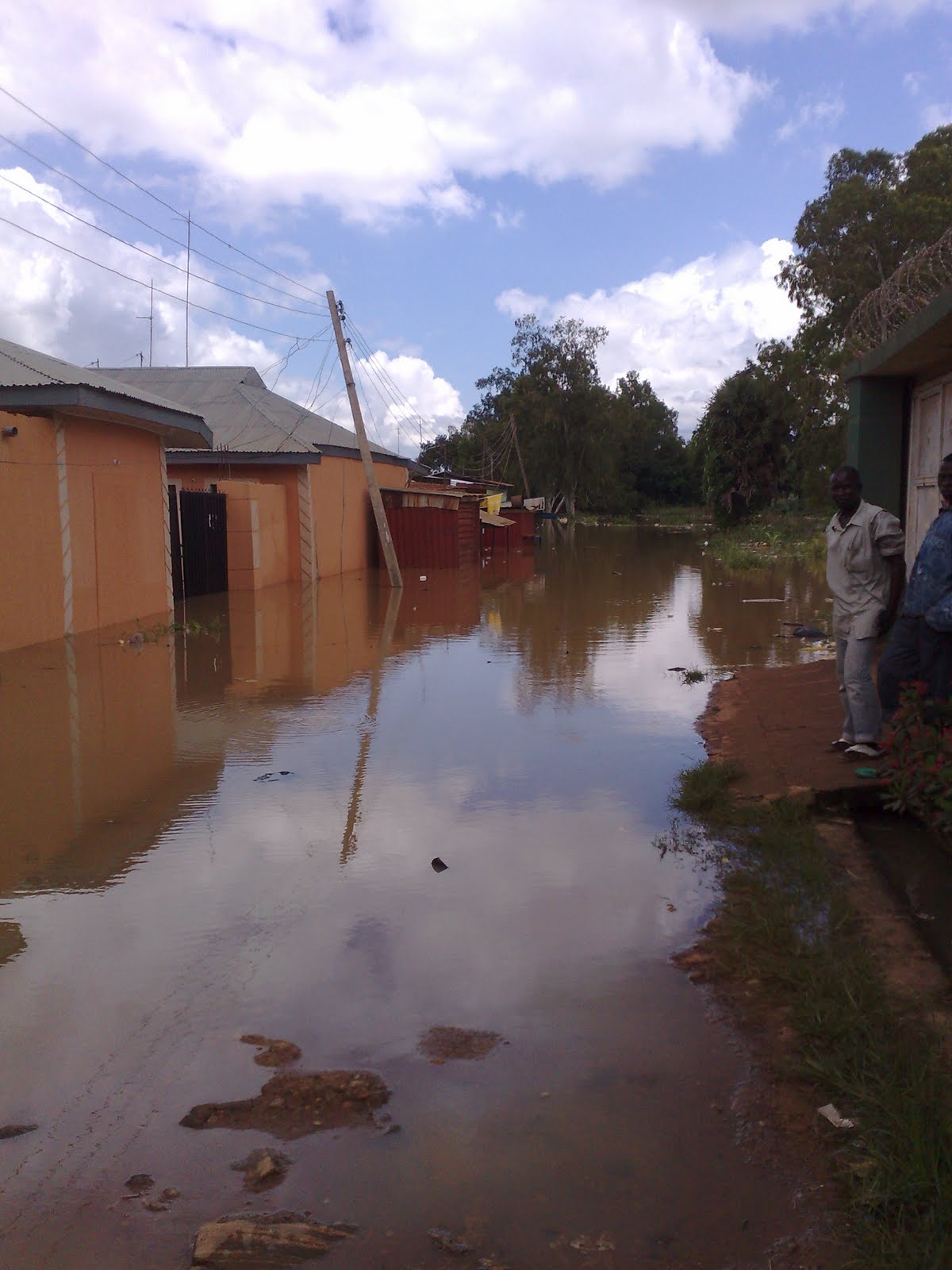
My road is well known for flooding; ever since I arrived people have looked at me slightly oddly when I’ve told them where I live. This look is followed by a statement along the lines of “don’t you know it floods there?!”. We live right next to the river and when it rises the only place for it to go is into people’s homes, which is exactly what happened two weeks ago.

The river on Friday afternoon. 
The river back to its normal level after the flood


During the week the intensity of the rain had increased consistently, until on Friday evening the drainage ditches along the main road were filled to the brim after a particularly heavy storm, and the river was at the highest I’d seen it since arriving.

The river on Saturday morning, the photo
from Friday was taken by the
furthest away building. 
I woke up on Saturday morning to find the end of my road impassable. The water was up to the roof of some houses and the street behind was the only way out for cars and pedestrians without a canoe. 

Despite having no rain for three days the river continued to rise, getting closer and closer to my house.  There was a constant huddle of people around the edge of the water, holding debates on how high it would rise, making use of the problem by washing their motorbikes, and generally happy to hold forth on their opinions about the river to anyone who would listen. The Nigerian Red Cross even turned up at one point, suspiciously timed for when the tv crews came to visit. They had an inflatable boat, and a couple of volunteers, but no one offered me any psychosocial support!
The Red Cross make an appearance.


Okada drivers taking the opportunity to wash their bikes in
the flood water.  


When I woke up on Monday morning the flood had reached the outside of our compound gate. This was the point at which we decided to leave, unfortunately, it was a little too late. The road behind the house had been passable by cars the day before but the water was up to peoples chests when they waded through it. The only way out of our area was through a hole in the wall of an empty compound - only big enough for pedestrians - which was thoughtfully created by a crowd of shouting men at around 6am.

I had forewarned my counterpart at the office on Sunday that we may need to leave in a hurry and luckily HVC has quite a few Land Rovers, so they sent the cavalry - our driver Shuaibu and a colleague Ruth. Unfortunately, the cavalry got stuck....they’d seen a Toyota hilux pass through the water and assumed a Land Rover could too, but the water overcame the engine and they called me to say they were stuck in the water.
Luckily with a combination of skilful driving from Shuaibu and luck they escaped the river and got through to us, only to have to repeat the journey to get us out again! 
A Hilux navigates the flood on the street behind ours, the
day before we were rescued. 

I spent the next week staying with two other volunteers in their nice dry house far away from the river, and came back to my house a week later to find everything dry, the water hadn't risen any higher than the compound gate... and there were ants in my peanut butter.
  

Monday, 2 August 2010

First Nigerian road trip

In July I was invited to a VSO market development workshop in Calabar. I was quite interested in the workshop, but even more curious about Calabar, the capital city of Cross River state in the far south of Nigeria, which is close to the border with Cameroon. How naive of me to think that the most exciting part of the week would be the city itself, I'd forgotten the excitement of getting there! 

My adventure began on the journey to Calabar from Kaduna which I undertook with my colleague Mercy. We had been assured that one of the best bus companies in Nigeria, Cross Country, ran a service from Kaduna to Calabar, which left at 7am on Sunday morning. We arrived at the motor park at 6.30am and purchasing our tickets we waited for a while for the bus to fill up... before at 7.45 being told that we were the only two going to Calabar, so they’d take us to their ‘other park’ across town where we could get a bus to Calabar. On arriving at Akwa Ibon Transport Company (not another park, a completely different company), we discovered the bus was 500N cheaper, and about ten times less comfortable than the Cross Country bus. Still reassured we were on the only bus leaving Kaduna for Calabar that day we hopped aboard and tried to find the most comfortable way to sit for the next 12 hours.

Driving across Nigeria is a hair raising experience at the best of times, and this was my first journey south of Abuja, where there is a remarkable difference in the quality of the roads compared to the north. At some points the main road turns into a mud track, more designed for a Land Rover than a minibus, and at others it is so full of potholes that drivers drive on the wrong sides of the road to avoid them, swerving only at the last minute. Our speed of travel averaged around 140 km per hour, and involved plenty of overtaking lorries on hills whilst being on the wrong side of the road to avoid pot holes. As a result of being unable to tear my eyes away from the road in case it caused us to crash (no logic, just fear) I didn’t get much sleep. This wasn’t too bad as the scenery was spectacular, the south is much wetter than the north, with dense forests, and the landscape is much more rolling which gives spectacular views.


 We passed through Lokoja and where the road crosses over the confluence of the rivers Niger and Benue, which is the widest river I’ve ever seen, and an impressive sight. This photo shows the river Benue at another point, imagine about triple this size for the confluence of both rivers, it can’t be captured on camera from a moving vehicle which is my excuse for not trying...


As we got further south, Mercy told me we might be going to Uyo - the capital of Akwa Ibom state – and not Calabar. This was confusing, as we’d been clearly told the bus was going to Calabar, and also slightly worrying, as VSO’s are warned on a weekly basis not to visit any Niger Delta states, due to their well known reputation as locations for kidnappings. At this stage I wasn’t really sure if Akwa Ibom was considered officially in the Niger Delta, or just next to it, and we couldn’t get another bus anyway so I just continued to follow our journey on my map with rising concern. We were passing through a police or army checkpoint roughly every 15 minutes, and it was when the second soldier asked our driver (jokingly) if he had kidnapped me with the memorable phrase “You no go say you done kidnap dis oyibo” that I was pretty sure we were in the Delta. It seemed only me who actually laughed at the joke, and whilst tempted to say yes, I thought Mercy might get angry with me, and so I refrained.

After a ten hour journey, we ended up in Uyo in the gathering dusk, still two hours from Calabar, and in the Niger Delta. Although at this point I was still blissfully ignorant (if vaguely suspicious) of my newly found VSO rule breaking status, even I realised that travelling in the dark is not very safe, so I was glad when Mercy was able to persuade our driver to take us on to Calabar. After another two hours of overtaking at breakneck speeds, in the dark on single carriageway roads, we made it to Calabar at 9pm, 13 hours after we set out. The hotel was worth the wait, there were huge rooms, hot showers, CNN and good food. Here's Mercy enjoying her hard earned garri and stew. 


My learning from this journey... don’t try and travel from Kaduna to Calabar in one day, and I've since learned all the Niger Delta states off by heart, just in case. 

I’ll add another post on the beauty of Calabar and what market development actually means soon.

Wednesday, 23 June 2010

World Cup Fever

Even when the world cup isn't on, the first question asked of someone from the UK visiting Nigeria is often "Which football team do you support?". Arsenal, Chelsea and Manchester United are all very popular among Nigerians, and on our street you can watch the most obscure British football games that probably wouldn't even be shown on tv in the UK. (This is probably something to do with rights... showing my ignorance of football here).

The excitement and momentousness of the first world cup held on African soil is not lost on Nigerians and the spirit here is very much one of 'Africa United'. Unfortunately last night Nigeria lost to South Korea, which means they haven't made it through the first round. But they will continue to support other African teams. When the opening match between South Africa and Mexico started I was in a workshop in Abuja, and the facilitator asked us to go outside and gather stones for an activity. This turned out to be an error as quite a few participants never made it back after being distracted by the match!

Nigeria and England's first games were both on the same day, and I watched the Nigeria game against Argentina in a crowded bar in Abuja, the room was filled with green shirts, plenty of passion and a few oyibos... here Bash refuses to take his eyes off the screen for a photo.


Unfortunately Nigeria lost, the general consesus was 'they done try-o', and there was plenty of hope for the other games.

After the game we hot footed it across town to the British Village (residence of the High Commission staff, and generously free for poor VSOs to use the pool) where they'd invited half the American embassy staff to watch the game. We scored - the Brits cheered, they scored - the Americans cheered LOUDER. Still they didn't have a baby dressed in an England flag, or this many flags... we even had party poopers with the England flag on thanks to Richard the third (there are three VSO Richards,, numbered in order of arrival).


We couldn't watch the last 10 minutes of the game due to poor tv reception, but as much as we hoped England might score when we weren't looking it wasn't to be. I'll be keeping my fingers crossed for our game in five hours. 

In other news, there are four new volunteers arriving in Kaduna soon, and a new Abuja volunteer visited us last weekend to learn about how to live in Nigeria - we spent most of the time watching football, which I think she found very useful! 

I also had malaria but am now fully recovered - it's just like having flu here, but felt much scarier than that to me. Luckily Hope for the Village Child have a clinic and I was tested as soon as I felt ill, so I was able to take the treatment straight away and only suffered a bad fever on the first night. 

Have been feeling very nostalgic about Glastonbury this week and wishing I was there. More news of my house mate dancing at the Hausa theatre and earning his keep to follow soon... 

Saturday, 5 June 2010

ABC, easy as 123...

May was a hectic month at Hope for the Village Child. Most people were busy visiting communities before the roads become impassable in rainy season. I was occupied with writing a fundraising proposal, and helping with fundraising visits in preparation for the reading festival which took place last Saturday. The reading festival was definitely the highlight of the month for me, and is the reason for this post.

The story of the reading festival


A couple of years ago HVC received a donation of hundreds of books from a bookshop which was closing down. They were mostly good quality children’s story books of the kind most children from poor rural communities would never see. HVC’s education coordinator Faith and a VSO volunteer sorted the books into categories, and created libraries for 16 schools in rural communities.

When I first heard this, I wasn’t that impressed, until I realised that these schools would otherwise have no story books at all - the schools have some text books from the government, and some from HVC but pupils are mostly taught by copying the teacher’s notes from the board – to really inspire children to enjoy learning these kind of books are vital.

When the libraries were constructed, the key objective was to encourage the students to use them, and this was the inspiration for the reading festival, which is now in its second year. It is a reading competition; each school with a library had one representative from year one to six. The youngest children only had to read letters of the alphabet chosen at random, but the older students had to read sections of their favourite book chosen by the judges (in order to prevent children memorising their books, although this does happen).

My role for the day was to be a judge on a panel of four, including Monique, a teacher from the Netherlands, Lynne and Sadiq.Here's the judging panel choosing a page for one student.


And a student from Panja reading her book.


The children were incredibly confident and clear, even those who were flummoxed when told to read from a page that they hadn’t memorised! Whilst most year one and two students could recognise letters of the alphabet, the level of reading done by year six students was much lower than I’d expected, reflecting the large class sizes and teaching by rote which they have to contend with in rural schools when learning to read.
The photo below shows children in the year one class at Panja school, one of the best performing schools in the competition. I've included this to give you an idea of the class sizes, note the number of pupils per desk.


The winning students from each year were given a prize of a new book; interestingly most of the winners were girls. Overall the day was a great success, and a way to encourage parents to support their children’s’ education. Monique said the overall standard had improved a lot from the year before, which was a really positive comment to end the day with and shows the impact which the libraries and HVC's education support to schools has made so far.


In other news from May, I attended my first Nigerian traditional wedding,here's me in my outfit with my colleague Stephen. Weddings here often have colours for family and friends to wear, for this one the choices were cream, lemon green or gold.


The wedding was swiftly followed by a roast dinner at the residence of the British High Commission in Kaduna. The kind of cultural juxtaposition faced only by VSO volunteers!

Friday, 7 May 2010

Public holidays and political events

This will be a memorable week for those with an interest in British or Nigerian politics. On Wednesday night the Nigerian President, Umaru Yar’Adua died, after a long illness, and on Thursday the acting president Goodluck Jonathan was sworn in as President. Whilst in the UK election was held yesterday, and at the time of writing has given us an unusual result, and no government as yet.

The momentous events in Nigeria prompted a public holiday, closing schools, government offices and some NGOs, like VSO, but not my organisation, HVC. The random thing about public holidays here is that they’re not announced until the very last minute... I only found out when on the bus into work (the downside of not owning a TV), and a colleague’s school children arrived at their school and were sent home again. Monday was also a public holiday here, known as workers day, similar to our May day at home, but again it was only confirmed as a public holiday in the middle of last week!

Although the title of this blog post suggests political speculation, I’m actually more interested in the public holidays. I spent the beginning of last weekend in Abuja, on Friday I went to a party held at the Hilton by the Dutch embassy in celebration of their Queen’s birthday. It was a very swanky event, with plenty of free wine, and more importantly all the cheese I could eat! On Saturday I went to the Guara waterfalls just outside Abuja for a picnic with some other volunteers and friends.


After spending the weekend in Abuja it was nice to have an unexpected extra day off on Monday. Richard, Elizabeth, Bertine and I went to the neighbouring city of Zaria to do some sightseeing. Zaria is an ancient city, which used to be a trading centre for goods from across the Sahara. Today it contains the fascinating Emir’s palace which is still in use by the current Emir of Zaria, and the crumbling remains of the city walls.

Here's the front of the emir's palace...


We weren’t able to meet the Emir at his palace, but we were allowed to sit in his visitor’s chairs and pretend we were guests of honour!


Following our visit to the palace, we went to what had been described in our guide book as ‘Zaria’s dye pits’. The use of the plural was somewhat misleading. It was a one man one slightly disused dye pit operation, and I’m pretty sure the crowd of twenty small children who surrounded us to stare had more fun than we did! Nonetheless the dye pit ‘Baba’ (father) spared the time to explain the dyeing process to us, and showed us a sample of his work. Meeting this charming elderly man more than made up for not seeing the dyeing process at work.


This week has been a busier one at work, I’ve got a big funding proposal to work on, and when not deciding who to vote by proxy for I’ve also been helping to fill the solar fruit dryer with mangoes and trying not to eat them all in the process. We’ve named the kitten Zippy, and he’s slowly becoming much calmer and less likely to bite my toes.